Last Friday, Google,
along with Blackberry, EarthLink and Red Hat, appealed to the Federal Trade
Commission and Department of Justice to take stronger action against companies
like Lodsys, Intellectual Ventures, and other “patent assertion entities”. They
believe those companies abuse patents for financial gain and are an increasing
detriment to the technology industry, costing U.S. companies alone nearly $30
billion in 2011 and $80 billion when accounting for all costs-direct and
indirect. This reminds me news I got last week about how Nokia sold its 125
patents to the patent holding company, Pendrell Corp. I wonder if Pendrell will
use those patents as a patent troll later. According to Matthew Bye, Google’s senior
competitor adviser, patent speculation hurts the interests of consumers and
patent trolls targeted more to the small companies, which hampering innovation
and undermine competition in the market.
Friday, April 12, 2013
Post 23: Take a stand against patent trolls!!
Post 22: Some updates about Apple this week
On Wednesday this week, Germany’s Bundespatentgericht
finally ruled in Apple’s favor that invalidated in its entirety the German part
of Samsung’s EP1005726 on a “turbo encoding/decoding device and method for
processing frame data according to Qos”. Previously, Samsung had declared that
the patent was essential to the third generation wireless standard. The ruling
is expected to impact on other lawsuits between the Samsung and Apple. Samsung
spokesman noted that they would decide whether to proceed with the appeal
later. However, since the Germany Federal patent court made the invalidation
decision, retrial could be detrimental to Samsung.
It seems like Apple
could take a deep breath; however, a not-so-good news came out on Thursday. A court
in Florida declined to ‘mop up a mess’ of multiple claims since the court
considered Apple and Motorola have no interest in efficiently resolving their
patent lawsuit. Judge Robert Scola stated that both Apple and Motorola greatly
expanded the scope of this patent litigation by, among other things, supplementing
patent infringement and invalidity contentions. The court denied to give the
two companies a case management conference to reduce the size and complexity of
the case.
I think I am 100%
agree the court’s decision. Everyone has to pay the price for his or her
mistakes. Similarly, the tow companies need to mop up the mass they made by
themselves instead of wasting taxpayers’ money. I still remember the stunning
iPhone press conference six year ago, when Steve Jobs announced to the world:”
Apple is reinventing the phone.” I don’t know how many people, like me, noted
his sly smile:” Of course, we applied for more than 200 patents to protect that
lead for at least five years of mobile phones.” The picture below tells us the
impact of iPhone to the smartphone industry.
In order not to let
competitors have been enjoying the innovation and technology, Apple tries to
use patent as a weapon to block its competitor. However, it is regrettable that
Apple’s approach didn’t make any competitor’s products eliminated from the
market; instead, some competitors had started to fight back using the similar approach. One of these patent battle centered around Apple's slide to unlock feature, which we talked about last week. Since then, we, as consumers, started to see this endless smartphone patent
war. I guess the future smartphone patent war may end in a cross license
agreement, but not until the final armistice. It may need to invest more time
and money. It seems like Apple start to realize this so they try to simple the lawsuits
with Motorola. Although they have not been able to agree on how to accomplish
the goal to drop patents and claims, at least, they both have the willing to do
so, which is a good starter to settle in my opinion.
Friday, April 5, 2013
Post 21: Nokia sells patents: Nokia expects a turn
Last weekend, Nokia has sold a block of its patents to the
patent holding companying, Pendrell Corp. The sale consists of 125 patents and
patent application worldwide, 81 of which have been declared by Nokia to be
essential to applicable standards. The aggregate value is more than $12
billion. Pendrell has created a new wholly owned subsidiary, Helsinki Memory
Technologies (HMT) to manage the patents. Nokia will receive a license to all
of the patents acquired by HMT and to new IP developed by HMT. Nokia has always been the portable,
embedded flash technology pioneer in the field of development and evolution of the company. The 125 patent
and patent applications that are sold this time are widely used in electronic equipment,
involving more than 8000 models
of consumer electronic devices; such
as mobile phones, laptops, and tablets. We have to notice that this is the company’s
second major sale of patent since last June.
Nokia’s series of action
lead me to think of Motorola, the “big brother” in mobile communication industry.
However, compared to Nokia, Motorola’s situation is more passive. Is Nokia going
to be another Motorola? I hope not. Although Nokia has lost patent, the longstanding
cash cow, the huge number funds Nokia get now is very useful for them. If Nokia
use it properly, it can make more money through research and development. It
would be extremely helpful for the mitigation of the Nokia’s short-term crisis.
If Nokia wants to rise again, the most important approach is to explore new
content of mobile functionality. Patent won’t save Nokia forever. Nokia’s most serious
problems are the wrong judgments in the industry trend and delay in the introduction
of new products. Nokia’s current situation should alert some companies that are
willing to make money through patent wars. They should keep in mind that innovation
is the only approach that would keep the company in the industry.
Post 20: Apple tree falls the crowd push?
On Thursday of this week, Apple’s slide-to-unlock patent was invalidated
in Germany. Germany’s Federal Patent Court, Bundespatentgericht, ruled that all
claims of EP1964022 on “unlocking a device by performing gestures on an unlock
image” are invalid as granted, and additionally held that none of the 14
amendments proposed by Apple could salvage the patent.
This is not the only bad news Apple got. Earlier this week, USPTO gave
Apple a hard blow: they did a final judgment on Apple’s “rubber band” feature
patent is valid. Although Apple strongly respond that the patent does not run
to “death”, the decision from USPTO will have a huge negative impact to Apple
since the rejection is to a key patent claim, which has the potential to alter
proceedings in Apple vs. Samsung case. Apple accused of more than 20 types of
Samsung smartphone and two tablet computers infringe this patent technology.
Apple have done poorly in the recent patent cases, and lost cases in
Germany, U.K and Netherland. We all know that Apple is a company that takes a
good use of patents to protect themselves and attack rival companies. It seems
like no one can stop the pace of Apple patents. They even applied a patent for
“rounded rectangle”, which can combat a wide surface of patens. I cannot deny
that Apple’s patent war forces more and more mobile phone manufactures to
reexamine the importance of patents. They realize that patent is useful, and
sometimes, it can even be used as weapons to fight back rivals. Needless to
say, Apple gave a bas example in this regard. Apple should be aware that the
best way to beat the competition is to develop consumers’ favorite products.
Fighting competitor through lawsuit is just part of the game. I think if Apple
can’t continue its succeed in iPhone and iPad, then the patent litigation won’t
help too much, and Apple will face a daunting challenge. As Steve Job said” “Simple can be harder than
complex: You have to work hard to get your thinking clean to make it simple.
But it’s worth it in the end because once you get there, you can move
mountains.” Can Apple rise again after losing Jobs? We’ll see.
Friday, March 29, 2013
Post 19: Apple vs. Samsung: loss at both sides cannot do better than shaking hands
On March 26,
Administrative Law Judge, Tomas B. Pender of the United States International
Trade Commission (ITC) made an initial determination on demand in the
investigation of Apple’s complaint against Samsung. ITC published such
information on the official website, but did not open a preliminary detail of
the award. However, some people said Judge Pender reaffirmed the original
position in the preliminary decision that Samsung violated Apple’s 4 patents.
Judge Pender has made the preliminary ruling last October, found that Samsung
GALAXY S, GALAXY S II, GALAXY Nexus, GALAXY Tab, Smartphone and Tablet PC
products violated Apple’s 3 common patent and 1 design patent. However, in January
this year, ITC accepted Samsung’s request to reopen the case. The initial
verdict had been scheduled for April 1, but it come out 6 days earlier than
originally planned. The final judgment is scheduled for August 1. According to
the United States Tariff Act No. 337, ITC can advise the President against
importing allegedly infringing products. After the ITC makes its final
decision, the President has to decide if he wants to accept the verdict within
60 days. If it is ultimately ruled that Samsung violated Apple’s patents, and
the President accepted the result, part of Samsung products cannot enter U.S.
market. Since Samsung’s latest products are not involved in this case, and the
infringing products can avoid to be banned by developing other technologies,
which around Apple technology patents. Thus, it is expected that Samsung’s U.S
portfolio will not be affected too much.
In addition, ITC
will make the final judgment on the case that Samsung sued Apple infringed it
patent on May 31. ITC made an announcement on 13th of this month
postponed the date of the final judgment. It said that it was necessary to
learn how much it was going to influence if the allegedly infringing Apple
products were banned to the U.S. market. The above statement seems implies that
ITC preliminary decision Apple did exist violations; outcome is expected to be
conducive to Samsung.
It seems like
Samsung will lose the most recent ITC lawsuit. However, patents provide Samsung
with a high degree of brand visibility and reputation. In the recent market
share, Samsung exceeds 30%, which is on the global top spot, while Apple is
only about 14%. Samsung lose the case, but win the market. How can you tell who
the winner is? It seems like Apple hopes to against Samsung’s intentions
through patent warfare fell, then why Apple initiates the patent war? Can patent war really play a role against the
competitor? I doubt it. I do agree that patent warfare would be a good weapon
as long as finding the right target. However, we all know that patent litigation
is a long and protracted war. It may last for months or even years which caused
immeasurable losses to the parties.
Apple and Samsung’s century patent was lasted form April 2011 till now,
complicated protracted litigation is not only affecting the progress of both
product development and marketing, but also damage both parties’ corporate
image at various degrees. It is worth to notice that although Samsung has won
the market share, but lose the lawsuit and pay compensation to Apple; Apple won
lawsuits to obtain compensation, but its market share has been left far behind
by Samsung. I think patent litigation is more like a double-edged sword, which
can effectively protect their own innovation, but the complexity of patent
litigation would hinder the pace of innovation in a certain extent. In general,
patent wars are unable to separate the real winner, most patent fight lost at
both sides. Apparently, it could not be implemented to fight against rivals
through patent warfare because it takes a lot of resources, and might not get
the ideal result. Thus, instead of losing on both sides, why not shake hands
and achieve the win-win situation together.
Post 18: Apple’s Siri got into Trouble in China
The news from cnet titled “Apple lands in Chinese court to
battle Siri patent suit”. The pretrial
was held on Wednesday of this week (PST). The case pits Apple against Zhizhen
Network Technology, which claims a patent for the voice-recognition software
used by Siri. Zhizhen Network
Technology’s claim is related to the patent number ZL200410053749.9 for a chat Robot.
The chat robots can receive user statement and give intelligent answers through
artificial intelligence server and database. Zhizhen Network believed that, by comparison,
Siri on iPhone4S used Zhizhen’s patented network technology illegally, and its implementations
fell into the scope of protection of a patent, ZL200410053749.9, for invention.
According to Xinhua, Zhizhen Netwrok had sent a letter to Apple trading company
and Apple, and tried to resolve this dispute through consultations, but they
did not reply. Later on, Zhizhen sued to court, requested Apple immediately
stop manufacturing, selling and using any products that infringed patent number
ZL200410053749.9.
At the same time,
Apple defensed that Zhizhen Network did not clearly descript its patent protection
range, which led its franchise protection range undetermined, yet Zhizhen did
not provide full effective evidence that proved Siri in iPhone4S fell into its
patent right requirements of protection range. Thus, Apple thought two
technology features were different and Siri application did not constitute infringement.
Apple has mad invalid declaration request, but the Court has not given the
permit yet.
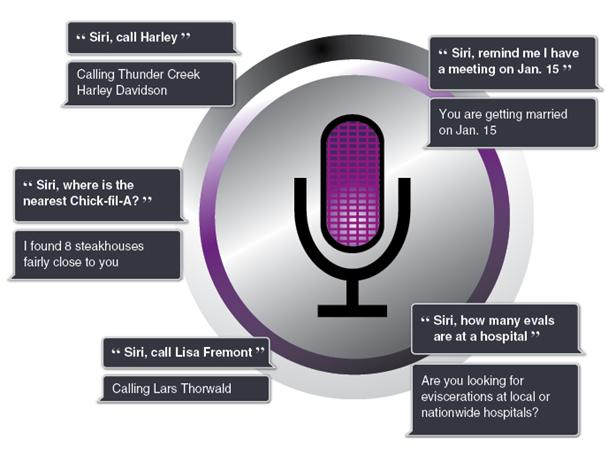
I find this case is
interesting because this is the first time the “littlee secretary”, Siri, encounter
the patent infringement disputes. However, Sir is an essential feature for smartphone,
which allows the phone turned into a “talking cellphone”. After Apple’s launch,
Siri has become one of Apple’s key product research and development in the future.
Siri has been used in many Apple’s new products, such as iPhone5, iPadmini.
However, Zhizhen claimed that they committed to the development and application
of this technology as early as 2003 and the patented technology has been widely
used in Microsoft’s MSN robot, Expo Haibao robot and so on. Actually, Zhizhen
started the lawsuit proceeding 3 days after the sale of Apple iPhone 4S;
however, since the case involve U.S company, which has to serve through
diplomacy. Thus, the case is officially put on schedule recent days.
So far, what seems
to be he biggest issue of the case?
I think technical
plan comparison will be the big argument between these tow companies. It is
said that Siri technology has gotten the international patens, while Zhizhen
has applied for patents in China. Since the court is held in China, I think it
is really worth to see how the Court judges the case, and which patent law the
Court will use. Surprisingly, the plaintiff’s petition did not involve compensation.
After reading the whole story, I think compare to infringement, it most likely
that these two companies start the voice software invention independently, but
they released the technology at different time and location. I believe it did
happen to some companies. That’s why I want to share this case. I think the
case might become an example for the future similar cases.
Friday, March 22, 2013
Post 17: Dispute Occurred Once Again – Some News about Nokia
On Tuesday of this
week, Nokia won a German patent injunction against HTC. According to FOSSPATENT’s
author, Florian Mueller, Mannhein local court found HTC had violated Nokia’s
power saving patent, which saves battery life when connected to a network.
Nokia could also enforce a sales ban by posting a $6.5 million bond and possess
the right to claim damages. At the same time, Nokia said it had asserted the power
saving patent against HTC in the UK and the U.S International Trade Commission,
with a hearing in the U.S to start in two months.
It seems like the competition
between Nokia and HTC escalates. Nokia has collected about 40 HTC’s patent
about mobile communication, and claimed that HTC violated Nokia’s intellectual
property rights. Earlier this month, the Court has dismissed Nokia’s claim to
HTC. Although it seems like Nokia has won this round, it is still hard to tell
how much this ruling can change Germany mobile market. Plus, it is still an argument
about whether this ruling is a major victory between Nokia and HTC. In HTC’s
statement, they claimed the ruling only affected three devices, Wildfire S,
Desire S and Rhyme, which were no longer put in the Germany market. HTC also
stressed that their Germany business would not be affected by the ruling. At
the same time, Nokia has hailed the victory, saying, “HTC must now respect our intellectual
property rights and use their own innovation competition.” Mueller believed HTC’s
statement was only partially right, and he claimed the infringement relating to
these devices is “classic”, but not only these three devices.
I’m not sure if
Nokia’s cheer is really about the “respect” they have about intellectual
property, or the benefit the intellectual property can bring. I remember
earlier this month Nokia filed brief to support Apple’s request to block sale
of Samsung products. The reason Nokia gave was that once the precedent had been
started, patent holders’ right to request to ban the sale of infringing products
would be weakened. Interestingly, Nokia and Apple had a patent dispute in 2011.
Nokia ended to pay royalties to Apple. It seems like there is no enemy forever.
The companies are willing to corporate in order to maximum the profit.
Nevertheless, I think Nokia is overacting on protecting their own patent as
Apple. I just feel like Nokia has put too much time concentrate on their patent
protection, but ignoring their innovation and advertisement. Comparing to Apple
and Samsung, when is your last time to hear any new and excited products from
Nokia? Several months ago, a year ago, or maybe longer. Honestly, I can’t remember
it myself. It’s true that Nokia holds a lot of good patents, but how long can
they live depend on their patent alone. According to the patent law, the patent
term is only 20 years from the filing date of the earliest U.S application to
which priority is claimed. How many of their patents will be expired in the
next few years? I do agree that they should learn from Apple, but not only the way
how Apple protect their intellectual properties, but also the way how they
invite new devices and advertise to attract costumers.
(Nokia posted this cartoon on Twitter, named "Guess who's who" on the day when Samsung released Galaxy S4)
Nokia, remember you
are a big company, but not the king of the market. Please don’t do this kindergarten
thing again.
Subscribe to:
Posts (Atom)


